
Chinooks Explained: Why Calgary Winters Change So Fast
Chinooks Explained: Why Calgary Winters Change So Fast
If you have spent a winter in Calgary, you have probably seen it: a bitter cold morning, then a warm wind from the west, melting snow by afternoon and puddles in the street. That wind is a chinook, a warm, dry, gusty westerly wind that blows down from the Rocky Mountains. In southwestern Alberta about one winter day in three is a chinook day, according to The Canadian Encyclopedia, and temperatures have been observed to rise by 27°C in just two minutes.
Our guide to what newcomers should know about Calgary winters gives chinooks a short mention. This post goes further: how a chinook forms, how to spot one coming, how often they arrive, what they change around your home and on the road, and what research says about chinooks and headaches.
Key Takeaways
- A chinook is a warm, dry wind off the Rockies. Milder air from the west pushes out cold Arctic air and warms further as it comes down the mountains.
- They are common. Environment Canada estimates Calgary sees about 25 chinook days each December to February, or roughly one every three or four days.
- The swings are large. Temperature jumps of 20 to 30 degrees are not uncommon, and winds can gust to 100 km/h.
- Melt by day means ice by night. Snow that melts in a chinook often refreezes overnight on sidewalks, driveways and roads.
- The headache link is mixed. A 2000 study found higher migraine odds for some adults on certain chinook days, while a 2025 University of Calgary study of young people found no link.
1. What Is a Chinook?
The Canadian Encyclopedia describes chinooks as warm, dry, gusty, westerly winds that blow down from the Rocky Mountains. In Calgary, that means a cold winter spell can break within hours as the wind shifts and warm air arrives.
The name has an interesting history. Environment Canada meteorologist Kirk Torneby told CBC Calgary that the name chinook coincides with an Indigenous name meaning "snow eater." Anyone who has watched a snowbank shrink in an afternoon will understand why.
Historians tell a slightly different story about the name itself. The Encyclopedia of the Great Plains traces it to the Pacific Northwest fur trade, where a westerly breeze blew up the lower Columbia River from the direction of the Chinook villages. Settlers later carried the name inland to the Prairies by the 1880s. The same source calls the idea that chinook is an Indigenous word for "snow eater" a common but unproven story, so "snow eater" is best thought of as a nickname rather than a translation.
2. How Does a Chinook Form?
A chinook is the result of air crossing the Rockies from west to east. The Canadian Encyclopedia explains it in three parts:
- Cold air is replaced by milder air. In a Calgary winter, cold Arctic air often sits over the city. When a chinook arrives, milder maritime air from the west replaces it. The Encyclopedia gives the average temperature of Arctic air at Calgary's elevation as minus 24°C, compared with minus 2°C for the milder maritime air.
- The air loses its moisture on the way over. As air rises up the western side of the mountains, it cools and drops rain or snow. The heat that went into turning that water into vapour is released back into the air, which warms it.
- The air warms again coming down. As the wind flows down the eastern slopes toward Calgary, it warms further and becomes drier, with humidity sometimes falling to 25% or less.
3. How Can You Tell a Chinook Is Coming?
Look west. The best known sign is the chinook arch. As CBC Calgary describes it, warm air gliding off the mountains creates a strip of clear sky along the horizon, between the ground and a straight line of cloud. Kirk Torneby explained that a wave develops in the atmosphere and creates that very sharp cloud edge.
Other clues are a forecast calling for strong westerly winds and a sudden rise in temperature after a cold spell.
Check the overnight low, not just the high
A chinook forecast often shows a mild afternoon. The number that matters for your morning walk or drive is the overnight low. If it drops below freezing after a warm day, expect ice.
4. How Often Do Chinooks Happen, and How Big Are the Swings?
Sources measure chinooks slightly differently, so the figures below are shown with where each one comes from.
| Measure | Figure | Source |
|---|---|---|
| Chinook days in southwestern Alberta | About 1 in 3 winter days (1 in 5 in northeastern Alberta) | The Canadian Encyclopedia |
| Chinook days in Calgary | About 25 per December to February, roughly one every three or four days | Environment Canada, via CBC |
| Typical temperature swing | 20 to 30 degrees is not uncommon | Environment Canada, via CBC |
| Fastest rise observed | 27°C in 2 minutes | The Canadian Encyclopedia |
| Canadian record temperature change | 41 degrees, from minus 19°C to 22°C, Pincher Creek, January 10, 1962 | Global News |
| Wind speed | 16 to 60 km/h, gusting to 100 km/h | The Canadian Encyclopedia |
| Relative humidity | Sometimes 25% or less | The Canadian Encyclopedia |
The Canadian Encyclopedia does not say where that two minute jump was recorded, and it was not necessarily in Alberta. A well known example of a jump that size comes from Spearfish, South Dakota, where the temperature rose from minus 4°F to 45°F (about minus 20°C to 7°C) in two minutes on January 22, 1943, according to the US National Weather Service. Closer to home, Global News reports that Pincher Creek in southern Alberta holds the Canadian title for the most dramatic temperature change, a 41 degree rise on January 10, 1962.
Not every winter is the same. Some bring long cold spells with few chinooks, and others bring one warm break after another. Either way, it helps to expect sudden changes rather than a steady winter.
5. What Do Chinooks Change Around Your Home and on the Road?
The Canadian Encyclopedia notes that a chinook melts snow, dries soil, dries out plants and contributes to soil erosion. A study of a January 1965 chinook by University of Calgary researchers, published in the journal Atmosphere in 1968, recorded snow cover in the study area falling from complete cover to about 70% during the event. For a homeowner or driver, that fast melt has a few practical effects.
Around your home
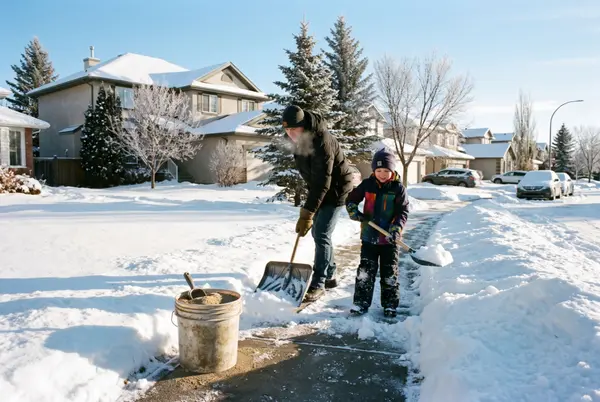
- Meltwater on sidewalks and driveways can refreeze overnight. Under the City's bylaw, ice on the public sidewalk next to your home has to be dealt with too. Our guide to Calgary's snow and ice bylaw covers the rules and timelines.
- Keep a bag of ice melt or traction grit by the door for the morning after a chinook.
- Fast melt needs somewhere to go. The City of Calgary asks homeowners to keep downspouts clear and pointed away from the foundation, and to shovel snow away from the foundation and window wells to prevent basement seepage. Government of Canada flood guidance suggests clearing snow about 1 to 1.5 m back from the foundation where possible.
- Melting roof snow can refreeze at the eaves and form ice dams. Natural Resources Canada notes that a well sealed, well vented attic stays colder and is less prone to ice dams. If ice dams keep coming back, federal guidance suggests having a professional check your attic insulation.
- Chinook air is very dry. Health Canada recommends keeping indoor relative humidity between 30% and 50%, and a simple humidity meter lets you check.
- Strong gusts can move patio furniture, bins, fence gates and holiday decorations, so secure loose items when high winds are forecast.
On the road
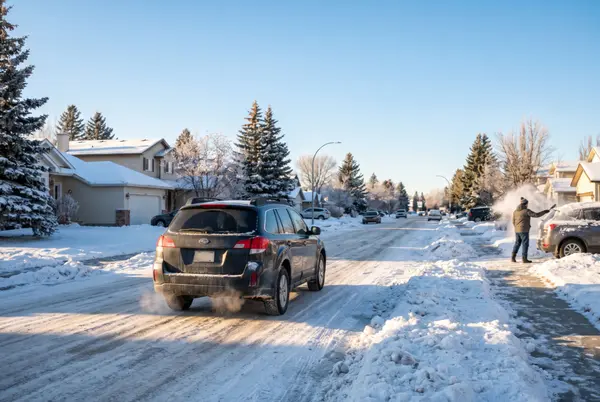
- Slush in the afternoon can turn into black ice by the next morning, especially on side streets and in shaded spots.
- Wet roads also mean dirty windshields, so keep washer fluid topped up.
- Our guide to winter driving in Calgary covers tires, snow routes and driving on ice.
6. Do Chinooks Cause Headaches?
Many people believe so. The Canadian Encyclopedia notes that while most people enjoy the break from the cold, a significant minority report discomfort such as headaches. The research is mixed:
- A 2000 study of adults. Published in the journal Neurology, it found that the day before a chinook, and chinook days with high winds over 38 km/h, were linked to a higher chance of migraine in a subset of people who get migraines. It did not find this for everyone.
- A 2025 study of young people. University of Calgary researchers followed 60 young people aged 8 to 18 and, in a paper published in the journal Headache, found no relationship between chinook conditions and the start of migraine attacks. The authors noted that the study was small.
In short, chinooks may be a trigger for some people but not for most. If you notice a pattern in your own headaches, keeping a simple diary and talking to your doctor is the best next step.
7. How Do You Live With Chinooks as a Newcomer?
- Dress in layers. A day that starts at minus 20°C can end near or above freezing, so layers you can remove work better than one heavy coat.
- Plan for the morning after. Leave a few extra minutes for icy sidewalks and roads after a warm day.
- Keep winter gear handy. Cold air usually returns, so do not put away the shovel, boots or scraper after a warm spell.
- Enjoy the break. A chinook afternoon is a good time for a walk, a pathway bike ride or clearing the driveway in comfort.
Frequently Asked Questions
What is a chinook in Calgary?
A chinook is a warm, dry, gusty westerly wind that blows down from the Rocky Mountains. It replaces cold Arctic air over Calgary and can raise the temperature sharply within hours, often melting snow in a single afternoon.
How often does Calgary get chinooks?
Environment Canada estimates Calgary sees about 25 chinook days from December to February, roughly one every three or four days. The Canadian Encyclopedia puts it at about one winter day in three for southwestern Alberta.
How much can the temperature change during a chinook?
Temperature swings of 20 to 30 degrees are not uncommon, according to Environment Canada. The Canadian Encyclopedia notes that a rise of 27°C in just two minutes has been observed.
What is a chinook arch?
A chinook arch is a strip of clear sky along the western horizon, between the ground and a straight edge of cloud. It forms as warm air flows off the mountains and is a common sign that a chinook is arriving.
Do chinooks cause headaches?
The research is mixed. A 2000 study in Neurology found higher migraine odds for a subset of adults the day before a chinook and on high wind chinook days, while a 2025 University of Calgary study of young people found no link. Talk to your doctor if you notice a pattern.
Why do sidewalks get icy after a chinook?
A chinook melts snow quickly during the day. When cold air returns or temperatures drop below freezing overnight, that meltwater refreezes into ice on sidewalks, driveways and roads, so mornings after a chinook can be the most slippery.
More Winter Guides for Newcomers
Getting ready for your first Calgary winter? These Bowhaven guides cover the rest.
New to Calgary?
Chinooks are one of the things that make Calgary winters easier than many newcomers expect. If you are planning a move and want help choosing a neighbourhood, Viren is happy to talk it through.
Published: November 5, 2026.
Categories
- All Blogs (74)
- About Calgary (2)
- City Services & Programs (3)
- Downsizing (1)
- Downtown Calgary (3)
- Families with Kids (19)
- Family Adventure Guides (2)
- First Time Home Buyers (16)
- Market Watch (5)
- Mortgages (6)
- Neighbourhood Spotlights (13)
- New to Calgary (16)
- NW Calgary (13)
- Parent Life & Family Wellness (1)
- Renovations & Repairs (2)
- Schools & Education Boards (6)
- Seasonal Family Activities (1)
- SW Calgary (2)
- Weekend Activity Guides (4)
- When Buying (21)
- When Refinancing (2)
- When Selling (16)
Recent Posts