
Simple Routines That Actually Reduce School-Day Chaos
Smoother Mornings: Simple Routines That Actually Reduce School-Day Chaos
School mornings do not have to end in a search for a missing shoe and a slammed car door. Here is the direct answer: the single biggest fix is not an earlier alarm, it is three things done consistently, prepping the essentials the night before, holding a steady wake time even on weekends, and cutting the number of decisions a child has to make before the bell rings. None of these require a full household overhaul, and most families can put them in place within a week.
This guide walks through the specific routines that make Calgary school mornings calmer, drawn from sleep research and child-development experts rather than guesswork. It covers what to prep the night before, why a consistent wake time beats an early one, how to reduce decision fatigue for kids of different ages, a visual checklist approach for younger children, a sample morning timeline families can adapt to their own school's start time, and what to do when a morning goes sideways anyway.
Key Takeaways
- The night before matters more than the morning itself. Laying out clothes, packing lunches, and staging backpacks the night before removes most of the friction before it ever starts, according to the Child Mind Institute.
- A consistent wake time beats an earlier one. The Sleep Foundation notes that letting a child's wake time drift more than an hour, even on weekends, can make weekday mornings harder to hold steady, not easier.
- Fewer choices mean less resistance. Child psychologist Dave Anderson, PhD, of the Child Mind Institute recommends narrowing a young child's morning to three non-negotiables, getting dressed, eating something, and brushing teeth, rather than a long list of demands.
- Visual checklists give younger kids real independence. Posting a simple picture-based routine where the task actually happens helps children reference the steps themselves, per Sesame Workshop.
- How a parent reacts when a morning goes wrong matters as much as the routine itself. Staying calm and praising small wins keeps stress from compounding, rather than arguing over what did not get done.
1. Why Do School Mornings Feel So Chaotic?
Mornings compress an unusually large number of small decisions into a short window, right after waking, when a child's self-regulation is naturally at its lowest for the day. What outfit, what breakfast, where is the second shoe, has the permission slip been signed, all of it lands at once, and every question a child has to answer or a parent has to manage adds to the friction. The Child Mind Institute points out that bedtime is one of the hardest transitions of the back-to-school season for exactly this reason, a summer schedule of later bedtimes and looser mornings has to reverse itself in a matter of days, and the body and the household routine both resist the sudden change.
The routines below are not about running a stricter household. They are about removing decision points before they happen, so the morning itself has fewer places to go wrong.
2. What Should Get Done the Night Before?
The Child Mind Institute puts night-before preparation at the center of a calmer morning, because it moves time-consuming decisions out of the rushed window before school and into a calmer stretch of the evening, when everyone has more patience left.
- Lay out the next day's clothes, including socks and shoes. A full outfit, chosen the night before, removes the single most common source of morning stalling.
- Pack lunches and snacks, even partially. Sandwiches can wait until morning for freshness, but containers, napkins, and non-perishables can all be set out the night before.
- Load backpacks and stage them by the door. Homework, library books, and signed forms go in the bag the moment they are ready, not the moment the bus is due.
- Finish any school paperwork right away. Permission slips and forms signed the evening they arrive never become a morning scramble.
- Walk through tomorrow's plan out loud with your child. A quick, thirty-second preview of what the morning will look like reduces surprises and gives younger children a sense of what is coming.
3. Why Does a Consistent Wake Time Matter More Than an Early One?
What the Research Actually Says
The Sleep Foundation reports that children with consistent routines fall asleep faster, sleep longer, and wake less often overnight, and that these benefits carry forward into better school readiness, cognitive skills, and mood. Just as importantly, consistency has to hold on weekends too, letting a wake time drift more than about an hour on Saturday and Sunday can make it harder to fall asleep on the following school night, undoing part of the week's progress. The encouraging part is that it does not take long to see results, the Sleep Foundation notes that a consistent routine can produce measurable improvement in sleep quality within just a few nights.
In practice, this means a fixed wake time, held within about an hour every single day of the week, does more for a smoother morning than an earlier bedtime alone. A child who wakes at a predictable time has a body clock that is working with the routine rather than against it, which is part of why the same wake-up battle can ease noticeably once the time actually stays consistent for a week or two.
4. How Can Parents Reduce Decision Fatigue for Kids in the Morning?
Every choice a child makes in the morning, however small, uses up a limited amount of cooperation and patience before the day even starts. The Child Mind Institute's Dave Anderson, PhD, recommends narrowing the morning down to three essential tasks and building the routine around those alone, getting dressed, eating something, and brushing teeth. As Dr. Anderson puts it, once a family can reliably get those three things done, everything else becomes easier to layer on top.
A Small Change That Makes a Real Difference
Instead of asking an open-ended "What do you want to wear today?", which hands a tired child an unlimited menu of choices to sort through, two shirts are laid out the night before and the question becomes "Blue or green?" The decision still belongs to the child, but it is bounded, quick, and does not require negotiating from scratch every single morning.
A bounded choice still gives a child ownership over the decision, without turning it into a ten-minute negotiation.
5. How Does a Visual Morning Checklist Help Younger Kids?
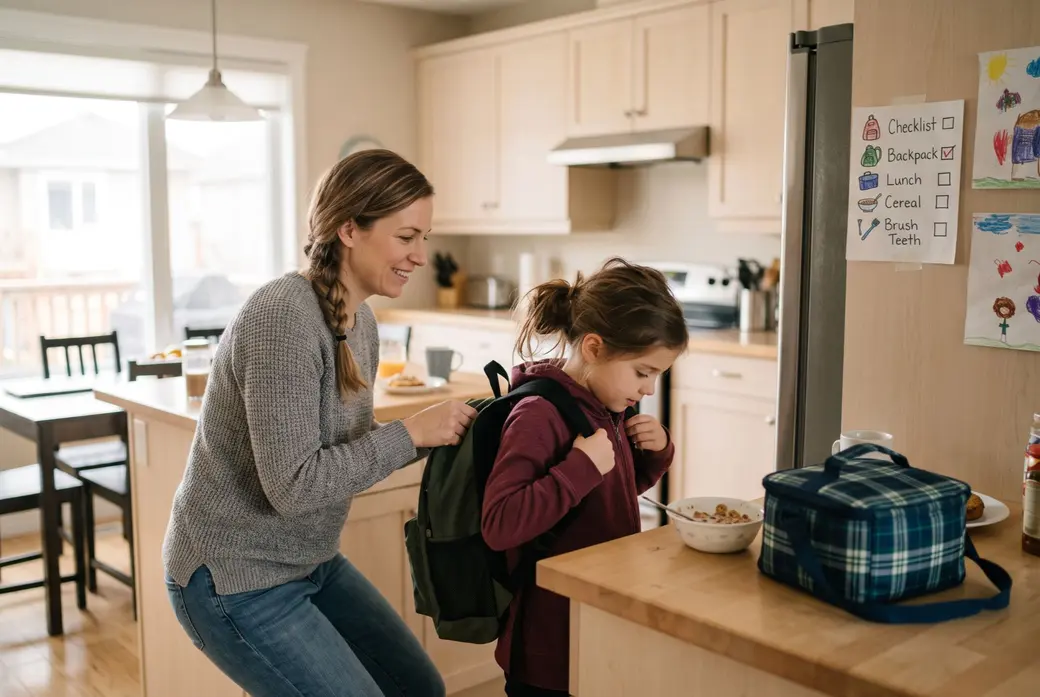
For children who are not yet reading fluently, a picture-based checklist does the work that a written list does for an older child. Sesame Workshop notes that children thrive on structure and predictability, and that a visual schedule helps them feel a genuine sense of control and build confidence about what is coming next in their day. The Child Mind Institute adds a practical detail, a picture posted right where the task happens, a toothbrush icon taped near the bathroom sink, for example, works especially well for children who need an extra visual cue to stay on track, including many kids with ADHD or autism.
A simple version costs nothing to set up. Five or six icons, wake up, get dressed, eat breakfast, brush teeth, pack backpack, shoes on, printed or hand-drawn on a strip of paper and taped to a bedroom door or bathroom mirror, give a young child something to check off themselves rather than something a parent has to narrate every step of the way. Review it together each morning for the first week or two, and most children start moving through it independently well before that.
6. What Does a Sample School Morning Timeline Look Like?
The schedule below is an example only, adjust every time to match your own child's school start time and the number of children getting ready at once. This version works backward from an 8:45 a.m. bell, a common start time across Calgary elementary schools, and builds in a buffer rather than cutting it close.
| Time | Task | Why It Works |
|---|---|---|
| 6:45 a.m. | Wake up, same time every school day | Consistency trains the body clock, per the Sleep Foundation |
| 6:50 a.m. | Get dressed, using clothes laid out the night before | Removes a decision point before breakfast even starts |
| 7:00 a.m. | Eat breakfast | One of the three morning essentials the Child Mind Institute recommends prioritizing |
| 7:15 a.m. | Brush teeth and finish the visual checklist | The second and third of those three essentials, done in order |
| 7:25 a.m. | Shoes, coat, and backpack, already staged by the door | Nothing left to search for at the last minute |
| 7:35 a.m. | Leave for school | Built-in buffer before an 8:45 a.m. bell, without rushing |
7. How Should Older Kids' Routines Look Different?
As children grow into independent readers, the same principles hold, prep ahead, keep choices bounded, and reduce decision points, but the tools shift. A written checklist replaces a picture one, and the goal moves from supervision toward genuine independence.
Ages 5 to 8
- A picture-based checklist still helps, posted near the bathroom mirror or bedroom door
- Two pre-approved outfit choices laid out the night before, rather than an open closet
- Praise for each completed step, rather than only noticing what is missed
- A parent still checks in at each step, but does not do the step for the child
Ages 9 and Up
- A written checklist the child manages themselves, without a parent reading it aloud
- An alarm clock of their own, rather than a parent-delivered wake-up call
- Packing their own backpack the night before, checked but not redone by a parent
- Natural consequences for a forgotten item, rather than a rescue trip back home
8. What Should Parents Do When a Morning Goes Wrong Anyway?
Even a well-built routine has rough mornings. The Child Mind Institute's guidance for these moments is straightforward, stay calm, avoid arguing over what did not get done, and praise whatever effort did happen instead of focusing only on what is incomplete. Arguing in the moment rarely speeds anything up, it mostly adds stress on top of a morning that is already behind. Save the real conversation, about what to try differently tomorrow, for a calmer moment later in the day, not the five minutes before the bell.
Frequently Asked Questions
What is the single most effective way to reduce school-morning chaos?
Combining three habits at once works best, prepping clothes, lunches, and backpacks the night before, holding a consistent wake time even on weekends, and narrowing a child's morning choices to a small, bounded set rather than an open menu.
Does an earlier wake time actually help with morning chaos?
Not on its own. The Sleep Foundation notes that consistency matters more than an early wake time specifically, letting the wake time drift by more than about an hour, even on weekends, can undo the benefit and make weekday mornings harder to hold steady.
What is decision fatigue, and how does it affect kids in the morning?
It is the idea that a person's ability to make good decisions and cooperate wears down the more small choices they have to make in a row. A morning packed with open-ended questions, what to wear, what to eat, what to pack, uses up a child's patience before the day has even started, which is why bounding those choices ahead of time helps.
What three tasks does the Child Mind Institute recommend prioritizing every morning?
Getting dressed, eating something, and brushing teeth. Child psychologist Dave Anderson, PhD, recommends building a family's morning routine around reliably completing those three essentials before adding anything else on top.
Are visual checklists actually useful for young children, or just a nice idea?
Sesame Workshop points to real benefits, structure and predictability help children feel a sense of control and build confidence about what is coming next, which supports genuine self-regulation rather than just looking tidy on a fridge door.
How long does it take to see results from a new morning or bedtime routine?
Faster than most parents expect. The Sleep Foundation notes that a consistent routine can produce measurable improvement in a child's sleep within just a few nights, though building a fully independent morning habit around it usually takes closer to one or two weeks.
More Calgary Family Guides
Looking for more practical, Calgary-specific guidance for family life? Browse more Life in Calgary posts on the Bowhaven blog.
Published: September 1, 2026.
Categories
- All Blogs (66)
- About Calgary (2)
- City Services & Programs (1)
- Downsizing (1)
- Downtown Calgary (3)
- Families with Kids (17)
- Family Adventure Guides (2)
- First Time Home Buyers (16)
- Market Watch (3)
- Mortgages (5)
- Neighbourhood Spotlights (12)
- New to Calgary (12)
- NW Calgary (12)
- Parent Life & Family Wellness (1)
- Renovations & Repairs (2)
- Schools & Education Boards (6)
- Seasonal Family Activities (1)
- SW Calgary (2)
- Weekend Activity Guides (4)
- When Buying (19)
- When Refinancing (2)
- When Selling (14)
Recent Posts